UNCLEAN … MUST BE CUT OFF / LEVITICUS 7:20

START YOUR DAY RIGHT DAILY DEVOTION
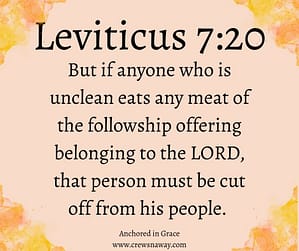
(KJV) Leviticus 7:20

But the soul that eateth of the flesh of the sacrifice of peace offerings, that pertain unto the Lord, having his uncleanness upon him, even that soul shall be cut off from his people.

The Weight of Holy Things: Reflecting on Leviticus 7:20 and True Worship

We live in a world that often treats the sacred with a sense of casual familiarity. We glide into worship spaces, sing songs, and partake in holy traditions with our minds drifting toward our to-do lists, or worse, with hearts harboring unconfessed sin and fractured relationships.

But a sobering warning echoed in Leviticus 7:20 pulls back the curtain on how God views insincere worship:

“But if anyone who is unclean eats any meat of the fellowship offering belonging to the Lord, they must be cut off from their people.”

To modern ears, being “cut off” sounds incredibly harsh. The book of Leviticus spends a vast amount of time defining what made a person ceremonially “unclean.” If someone in that state willfully stepped forward to participate in a sacred sacrifice or offering, they faced God’s immediate, severe judgment.

This rule wasn’t about keeping people away; it was designed to teach a crucial spiritual truth: It is wicked and disgraceful to act out of a false, insincere relationship with God. Holiness demands honesty. God desires our proximity, but He refuses to be a part of our hypocrisy.

From the Old Altar to the New Table

Lest we think this is strictly an Old Testament problem, the Apostle Paul sounds an identical alarm for the New Testament church. In 1 Corinthians 11:27-30, Paul addresses how the believers in Corinth were approaching Communion:

“So then, whoever eats the bread or drinks the cup of the Lord in an unworthy manner will be guilty of sinning against the body and blood of the Lord…”

Paul warns that partaking in the Lord’s Supper in an “unworthy manner”—irreverently, self-centeredly, without proper regard for God or others, and with no intention of repenting—brings judgment. In fact, he notes that some in the community had fallen sick or even died because they treated the holy table with careless disregard.

Examining Our Hearts

Both Leviticus and 1 Corinthians point us to the same vital necessity: self-examination.

God does not expect us to be flawless before we approach Him—if that were the standard, the altar and the cross would be useless. Rather, He demands that we approach Him with repentant honesty. Coming to God while actively clinging to sin, harboring bitterness toward a neighbor, or treating the sacrifice of Christ as a cheap routine is a dangerous spiritual game.

Before we offer our prayers, our songs, or our tithes, let us pause. Let us lay down our masks, confess our hidden uncleanness, and allow His grace to truly make us ready.

Closing Prayer

Heavenly Father,

We come before You recognizing that You are holy, righteous, and worthy of all our reverence. Lord, forgive us for the times we have treated holy things casually. Forgive us for stepping into Your presence with divided hearts, hidden sins, or pretense.

Search us, O God, and know our hearts today. Test us and know our anxious thoughts. Point out anything in us that offends You, and lead us along the path of everlasting life. Cleanse us from our secret faults and make our hearts a fit habitation for Your Spirit.

May our worship never be a mere performance. Grant us the grace to approach Your table and Your presence with pure motives, sincere repentance, and genuine love for You and our neighbors. We thank You for the blood of Jesus that makes us clean and allows us to draw near to You without fear.

In Jesus’ holy name we pray, Amen.

Affiliate Disclosure: This post contains affiliate links. If you make a purchase through these links, I may earn a small commission at no extra cost to you.

Bible Study Tools I Use

Some of our Post That Might Interest You, All Out of the Current Book / Chapter

  1. BREAD MADE WITH YEAST / LEVITICUS 7:13
  2. AGAINST THE ALTAR / LEVITICUS 7:2
  3. GUILT OFFERING / LEVITICUS 5:15
  4. FINE FLOUR FOR A SIN OFFERING / LEVITICUS 5:11
  5. HE MUST CONFESS / LEVITICUS 5:5
  6. OUTSIDE THE CAMP / LEVITICUS 4:12
  7. SIN OFFERING / LEVITICUS 4:3
  8. ANY FAT OR ANY BLOOD / LEVITICUS 3:17
  9. FELLOWSHIP OFFERING / LEVITICUS 3:1
  10. NOT ANY YEAST OR HONEY / LEVITICUS 2:11
  11. GRAIN OFFERING / LEVITICU 2:1-2
  12. AROMA PLEASING TO THE LORD / LEVITICUS 1:9
  13. SLAUGHTER THE YOUNG BULL / LEVITICUS 1:5
  14. LAY HIS HAND ON / LEVITICUS 1:4
  15. BURNT OFFERING / LEVITICUS 1:3
  16. BRINGS AN OFFERING / LEVITICUS 1:2
  17. CREWS N AWAY: ANCHORED IN GRACE

Thanks for stopping by the blog today! I love having you here. If this post resonated with you, please drop a comment below and share your thoughts. See you in the next post!

Blessings, Margarita & Stace
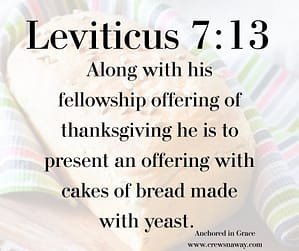
BREAD MADE WITH YEAST / LEVITICUS 7:13

START YOUR DAY RIGHT DAILY DEVOTION

(KJV) Leviticus 7:13

Besides the cakes, he shall offer for his offering leavened bread with the sacrifice of thanksgiving of his peace offerings.

The Holy Table of the Imperfect: Grace in Leviticus 7:13

When we read the Old Testament book of Leviticus, it can feel like a dense manual of rigid rules. God’s standard for holiness is incredibly high. One rule that appears consistently is the strict ban on yeast. In Leviticus 2:11, God commands that no grain offering brought to the altar should contain yeast. Throughout Scripture, yeast is a metaphor for sin and corruption—a tiny ingredient that quietly works its way through everything, altering its nature.

But if you read closely, God builds a stunning moment of grace right into the heart of the sacrificial laws. In Leviticus 7:13, during the instructions for the fellowship offering, we find a surprising twist:

“Along with their fellowship offering of thanksgiving they are to present an offering with cakes of bread made with yeast.”

Why the sudden change? Why would a holy God allow yeast into a sacred worship service?

The Altar vs. The Table

The answer comes down to geography. In other offerings, the bread was burned completely on the altar as a flawless gift to God. Because the altar represented God’s absolute, unblemished purity, yeast was strictly forbidden.

The fellowship offering, however, was fundamentally different. It was a communal peace offering. A portion was dedicated to God, but the remaining meat and bread were given back to the worshiper.

The family, the friends, and the priests would then sit down together to eat a massive celebratory feast. The leavened bread was never placed on the altar; it was placed on the dining table.

Welcomed, Yeast and All

By allowing bread made with yeast at this specific meal, God was illustrating a beautiful spiritual truth: He does not demand that we be flawless before He sits down to eat with us.

The fellowship offering was all about gratitude, peace, and relationship. God knew that the families sitting around that table were imperfect. They carried worries, human frailties, and daily struggles—the spiritual “yeast” of living in a broken world. Yet, God didn’t isolate Himself until they fixed everything. Instead, He invited them to pull up a chair and share a meal with Him exactly as they were.

The table of fellowship is the place where God’s holiness meets our human reality.

Pull Up a Chair

Today, we no longer bring literal loaves of bread to a temple, but the principle remains alive through Jesus Christ. Jesus became our ultimate peace offering, opening the door for us to have an uninterrupted relationship with the Father.

If you have been holding back from God because you feel too messy, too distracted, or too “leavened” by the chaos of life, look closely at Leviticus 7:13. God’s table has always had room for the everyday realities of our lives. You don’t have to wait until you are perfect to seek His presence. He is waiting to fellowship with you today.

Closing Prayer

Heavenly Father,

We marvel at the thoughtfulness of Your grace. Thank You that while Your holiness is absolute, Your love builds a table where we can sit in Your presence. Lord, we confess that our lives often feel full of “yeast”—the imperfections, the anxieties, and the mistakes of our daily human walk.

Thank You for not waiting for us to be flawless before inviting us close. We thank You for the ultimate peace we have through Jesus Christ. Help us to live with hearts full of thanksgiving, resting in the truth that we are fully known and deeply loved by You. Bring peace to our hearts and our homes today. In Jesus’ name, Amen.

Affiliate Disclosure: This post contains affiliate links. If you make a purchase through these links, I may earn a small commission at no extra cost to you.

Bible Study Tools I Use

Some of our Post That Might Interest You, All Out of the Current Book / Chapter

  1. AGAINST THE ALTAR / LEVITICUS 7:2
  2. GUILT OFFERING / LEVITICUS 5:15
  3. FINE FLOUR FOR A SIN OFFERING / LEVITICUS 5:11
  4. HE MUST CONFESS / LEVITICUS 5:5
  5. OUTSIDE THE CAMP / LEVITICUS 4:12
  6. SIN OFFERING / LEVITICUS 4:3
  7. ANY FAT OR ANY BLOOD / LEVITICUS 3:17
  8. FELLOWSHIP OFFERING / LEVITICUS 3:1
  9. NOT ANY YEAST OR HONEY / LEVITICUS 2:11
  10. GRAIN OFFERING / LEVITICU 2:1-2
  11. AROMA PLEASING TO THE LORD / LEVITICUS 1:9
  12. SLAUGHTER THE YOUNG BULL / LEVITICUS 1:5
  13. LAY HIS HAND ON / LEVITICUS 1:4
  14. BURNT OFFERING / LEVITICUS 1:3
  15. BRINGS AN OFFERING / LEVITICUS 1:2
  16. CREWS N AWAY: ANCHORED IN GRACE

Thanks for stopping by the blog today! I love having you here. If this post resonated with you, please drop a comment below and share your thoughts. See you in the next post!

Blessings, Margarita & Stace
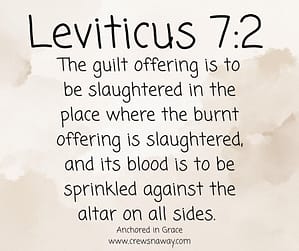
AGAINST THE ALTAR / LEVITICUS 7:2

START YOUR DAY RIGHT DAILY DEVOTION

(KJV) Leviticus 7:2

In the place where they kill the burnt offering shall they kill the trespass offering: and the blood thereof shall he sprinkle round about upon the altar.

Against the Altar: The Deep Significance of Leviticus 7:2

In the Old Testament, worship ceremonies—such as sacrifices and offerings—were much more than rigid rituals. They were a vital means of communication between God and His people. These ceremonies functioned as active, symbolic prayers by which the people admitted their sin, requested God’s forgiveness, and sought to maintain and renew their relationship with the Almighty. Through these dramatic symbols, God revealed His ultimate contempt for sin, His profound mercy toward His people, and exactly what He expected from them.

When we look closely at Leviticus 7:2, we find a precise and powerful instruction regarding the guilt offering:

“In the place where they kill the burnt offering they shall kill the guilt offering. And its blood he shall sprinkle all around against the altar.”

The Symbolism of the Blood Against the Altar

The phrase “against the altar” carries immense theological weight. The altar was the meeting point between a holy God and flawed humanity. By sprinkling the blood of the sacrifice all around and against the altar, the priests were visually demonstrating a profound truth: atonement requires covering.

  • Acknowledgment of Sin: The blood hitting the altar was a stark reminder that sin carries a heavy cost. It was an active confession that wrongdoing separates us from God.
  • The Visual of Mercy: As the blood covered the sides of the altar, it symbolized that the barrier of sin was being washed away by a substitutionary life, allowing the relationship with God to be renewed.
  • An Expression of Gratitude: Passing through this ritual allowed the Israelites to walk away with a clear conscience, turning their relief into deep gratitude and rededication to God’s laws.

From the Ancient Altar to the Cross

While we no longer bring animal sacrifices to a physical altar, the principle of Leviticus 7:2 points directly to the ultimate sacrifice of Jesus Christ. His blood was not just sprinkled on an earthly altar, but poured out on the cross to pay for our sins once and for all. Because of Him, we no longer need symbolic rituals to reach God; we have direct access to His mercy and forgiveness.

Whenever we feel the weight of our failures, we can look back at the lessons of the Old Testament altar and remember that God has always provided a way for us to be cleansed, restored, and brought back into perfect communion with Him.

Closing Prayer

Heavenly Father,

We come before You today recognizing the holiness of Your presence and the depth of Your grace. Thank You for the powerful reminders in Your Word, like the instructions in Leviticus, which show us just how seriously You view sin, but also how lovingly You provide a way for our forgiveness.

Lord, we thank You that we no longer have to offer sacrifices against a physical altar, because Jesus became our perfect sacrifice on the cross. We ask that You cleanse our hearts today. Where we have fallen short, let Your mercy wash over us. Renew our spirits, deepen our gratitude, and help us live lives that are fully dedicated to You.

In Jesus’ mighty name we pray, Amen.

Affiliate Disclosure: This post contains affiliate links. If you make a purchase through these links, I may earn a small commission at no extra cost to you.

Bible Study Tools I Use

Some of our Post That Might Interest You, All Out of the Current Book / Chapter

  1. GUILT OFFERING / LEVITICUS 5:15
  2. FINE FLOUR FOR A SIN OFFERING / LEVITICUS 5:11
  3. HE MUST CONFESS / LEVITICUS 5:5
  4. OUTSIDE THE CAMP / LEVITICUS 4:12
  5. SIN OFFERING / LEVITICUS 4:3
  6. ANY FAT OR ANY BLOOD / LEVITICUS 3:17
  7. FELLOWSHIP OFFERING / LEVITICUS 3:1
  8. NOT ANY YEAST OR HONEY / LEVITICUS 2:11
  9. GRAIN OFFERING / LEVITICU 2:1-2
  10. AROMA PLEASING TO THE LORD / LEVITICUS 1:9
  11. SLAUGHTER THE YOUNG BULL / LEVITICUS 1:5
  12. LAY HIS HAND ON / LEVITICUS 1:4
  13. BURNT OFFERING / LEVITICUS 1:3
  14. BRINGS AN OFFERING / LEVITICUS 1:2
  15. CREWS N AWAY: ANCHORED IN GRACE

Thanks for stopping by the blog today! I love having you here. If this post resonated with you, please drop a comment below and share your thoughts. See you in the next post!

Blessings, Margarita & Stace
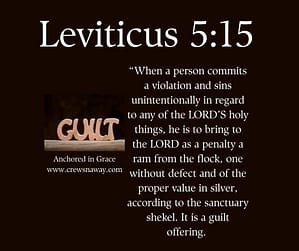
GUILT OFFERING / LEVITICUS 5:15

START YOUR DAY RIGHT DAILY DEVOTION

(KJV) Leviticus 5:15

 If a soul commit a trespass, and sin through ignorance, in the holy things of the Lord; then he shall bring for his trespass unto the Lord a ram without blemish out of the flocks, with thy estimation by shekels of silver, after the shekel of the sanctuary, for a trespass offering.

Restitution, Grace, and the Heart of the Guilt Offering

Have you ever accidentally damaged someone else’s property or realized, long after the fact, that you completely missed the mark on a commitment? That sudden sinking feeling in your stomach is something we all know too well: guilt.

In the Old Testament, God provided a specific way to handle this weight. Known as the Guilt Offering (or Asham), this ritual detailed in Leviticus 5:14–6:7 shows us exactly how seriously God takes both our vertical relationship with Him and our horizontal relationships with each other.

The Mechanics of the Guilt Offering

According to Leviticus 5:15, the guilt offering was commanded when someone was unfaithful to the Lord by sinning unintentionally regarding “the Lord’s holy things.” This could mean accidentally withholding a tithe or mishandling something dedicated to the tabernacle. Later verses expand this to breaking God’s commands unknowingly or violating another person’s property rights.

But the Guilt Offering required something unique compared to other sacrifices. God didn’t just ask for a ritual; He required restitution:

  1. The Sacrifice: The individual brought a flawless ram evaluated at the proper value of silver to the priest.
  2. The Repayment: The wrongdoer had to make full restitution for the damage caused.
  3. The Twenty-Percent Fine: On top of full repayment, they had to add an extra fifth (20%) of the value as a penalty.

God wasn’t just clearing a spiritual ledger; He was ensuring that the victim was made completely whole—and then some. It shows that true repentance isn’t just saying “sorry”; it actively seeks to repair the damage our actions cause.

Three Dimensions of Healing

The Guilt Offering beautifully mends three distinct fractures caused by sin:

  • The Vertical: It restores our relationship with God through atonement and forgiveness.
  • The Horizontal: It heals our relationship with our neighbors through tangible restitution.
  • The Internal: It clears our own conscience, lifting the heavy emotional and spiritual burden of guilt.

The Ultimate Guilt Offering

While we no longer bring rams to an altar, the spiritual reality of the Guilt Offering matters today. The prophet Isaiah used this exact sacrificial language to predict the mission of Jesus: “Yet it pleased the Lord to bruise Him… When You make His soul an offering for sin [Asham/Guilt Offering]” (Isaiah 53:10).

Jesus became our ultimate Guilt Offering. He paid the debt for our faithlessness, clearing our consciences completely. Because our spiritual debt has been paid by Him, we are free to love others extravagantly and make things right with those we have wronged, not out of fear, but out of immense gratitude.

A Closing Prayer

Heavenly Father,

Thank You for being a God of order, justice, and overwhelming grace. We confess that we often fall short—sometimes willfully, and sometimes without even realizing it. We ask for Your forgiveness for the ways we have been unfaithful to You and the ways we have harmed our neighbors.

Thank You for Jesus, who became our perfect Guilt Offering on the cross, paying a debt He did not owe to clear a conscience we could not cleanse on our own. Holy Spirit, give us the courage to make restitution where we have caused harm, and grant us the grace to live fully in the freedom of Your forgiveness. Cleanse our hearts today.

In Jesus’ name, Amen.

Affiliate Disclosure: This post contains affiliate links. If you make a purchase through these links, I may earn a small commission at no extra cost to you.

Bible Study Tools I Use

Some of our Post That Might Interest You, All Out of the Current Book / Chapter

  1. FINE FLOUR FOR A SIN OFFERING / LEVITICUS 5:11
  2. HE MUST CONFESS / LEVITICUS 5:5
  3. OUTSIDE THE CAMP / LEVITICUS 4:12
  4. SIN OFFERING / LEVITICUS 4:3
  5. ANY FAT OR ANY BLOOD / LEVITICUS 3:17
  6. FELLOWSHIP OFFERING / LEVITICUS 3:1
  7. NOT ANY YEAST OR HONEY / LEVITICUS 2:11
  8. GRAIN OFFERING / LEVITICU 2:1-2
  9. AROMA PLEASING TO THE LORD / LEVITICUS 1:9
  10. SLAUGHTER THE YOUNG BULL / LEVITICUS 1:5
  11. LAY HIS HAND ON / LEVITICUS 1:4
  12. BURNT OFFERING / LEVITICUS 1:3
  13. BRINGS AN OFFERING / LEVITICUS 1:2
  14. CREWS N AWAY: ANCHORED IN GRACE

Thanks for stopping by the blog today! I love having you here. If this post resonated with you, please drop a comment below and share your thoughts. See you in the next post!

Blessings, Margarita & Stace
FINE FLOUR FOR A SIN OFFERING / LEVITICUS 5:11

START YOUR DAY RIGHT DAILY DEVOTION

(KJV) Leviticus 5:11

But if he be not able to bring two turtledoves, or two young pigeons, then he that sinned shall bring for his offering the tenth part of an ephah of fine flour for a sin offering; he shall put no oil upon it, neither shall he put any frankincense thereon: for it is a sin offering.

Fine Flour for a Sin Offering: God’s Radical Grace for the Poor

In the ancient sacrificial system of Leviticus, the shedding of blood was central. It serves as a vivid, sobering reminder of the heavy cost of sin, ultimately pointing forward to Jesus’ final sacrifice on the cross. But a closer look at Leviticus 5:11 reveals a beautiful, easily overlooked window into the heart of God: His radical accessibility.

What happened to those who were so desperately poor that they couldn’t afford a goat or a lamb? God did not shut them out of His presence. He provided a tier of grace. If they couldn’t afford livestock, they could bring two doves or pigeons. And if they were too poor even for birds, God allowed them to bring a small amount of fine flour as a sin offering.

The Exception to the Rule

We often quote Hebrews 9:22, which reminds us that “without the shedding of blood there is no forgiveness.” Yet, the writer of Hebrews carefully includes the qualifier “nearly everything” is cleansed with blood. Leviticus 5:11 is that beautiful “nearly.”

By allowing a bloodless offering of fine flour for the destitute, God made it clear that poverty is never a barrier to pardon. He cared more about reconciliation with the brokenhearted than the market value of their offering. The flour was placed on the altar, and the priest made atonement for them, making the poorest beggar just as clean as the wealthiest ruler.

The Only Perfect Sacrifice

While the fine flour met the immediate need under the Old Covenant, it was still a temporary shadow (Hebrews 10:1-10). It had to be offered over and over again. As Hebrews 10:4 reminds us, “it is impossible for the blood of bulls and goats to take away sins”—and the same was true for flour.

These detailed offerings were placeholders until the arrival of the ultimate sacrifice. Jesus Christ’s death on the cross is the only perfect sacrifice that can truly and permanently take away sin (Hebrews 10:12, 14). Through Him, the barrier has been torn down forever. You don’t need to bring a lamb, a bird, or a handful of flour. Jesus paid it all, ensuring that salvation is absolutely free and available to every single person, regardless of status, wealth, or past mistakes.

Closing Prayer

Heavenly Father,

We thank You today for Your immense mercy and thoughtfulness. Thank You that from the very beginning, You made a way for the poor, the broken, and the forgotten to find forgiveness and near-access to Your heart. We praise You that poverty of spirit or pocket is never a barrier to Your grace.

Thank You, Lord Jesus, for being the ultimate, perfect sacrifice. You paid a debt we could never afford so that we could receive a righteousness we could never earn. May we rest securely today in Your finished work on the cross, knowing our sins are fully taken away. Help us to extend that same unconditional grace and accessibility to those around us.

In Jesus’ mighty name, Amen.

Affiliate Disclosure: This post contains affiliate links. If you make a purchase through these links, I may earn a small commission at no extra cost to you.

Bible Study Tools I Use

Some of our Post That Might Interest You, All Out of the Current Book / Chapter

  1. HE MUST CONFESS / LEVITICUS 5:5
  2. OUTSIDE THE CAMP / LEVITICUS 4:12
  3. SIN OFFERING / LEVITICUS 4:3
  4. ANY FAT OR ANY BLOOD / LEVITICUS 3:17
  5. FELLOWSHIP OFFERING / LEVITICUS 3:1
  6. NOT ANY YEAST OR HONEY / LEVITICUS 2:11
  7. GRAIN OFFERING / LEVITICU 2:1-2
  8. AROMA PLEASING TO THE LORD / LEVITICUS 1:9
  9. SLAUGHTER THE YOUNG BULL / LEVITICUS 1:5
  10. LAY HIS HAND ON / LEVITICUS 1:4
  11. BURNT OFFERING / LEVITICUS 1:3
  12. BRINGS AN OFFERING / LEVITICUS 1:2
  13. CREWS N AWAY: ANCHORED IN GRACE

Thanks for stopping by the blog today! I love having you here. If this post resonated with you, please drop a comment below and share your thoughts. See you in the next post!

Blessings, Margarita & Stace
HE MUST CONFESS / LEVITICUS 5:5

START YOUR DAY RIGHT DAILY DEVOTION

(KJV) Leviticus 5:5

And it shall be, when he shall be guilty in one of these things, that he shall confess that he hath sinned in that thing:

The Power of Honest Admission: Understanding Leviticus 5:5

In a world that often encourages us to excuse, minimize, or hide our flaws, the Bible offers a radically liberating alternative: confession.

In the Old Testament, the roadmap for restoration begins with a direct command. Leviticus 5:5 states: “When anyone becomes aware that they are guilty in any of these matters, they must confess in what way they have sinned.”

Here, God establishes a timeless truth. True forgiveness and healing always begin with an honest admission.

What Does It Mean to Confess?

To confess means to align our perspective with God’s. It is the moment we stop making excuses and admit that we have gone our own way, failing to reach His perfect standard of holiness. When we confess, we recognize that our thoughts, words, and actions have fallen short.

God does not demand confession to shame us, but to restore us. Scripture shows us that confession is the prerequisite for receiving His mercy (Hosea 5:15; 1 John 1:9).

The Essential Link: Confession and Repentance

Confession is only the first step; it is genuine only when followed by true repentance (Proverbs 28:13). While confession is the admission of sin, repentance is the turning away from it.

  • The Heart Shift: We turn our backs on the wrong behavior and turn our faces toward God.
  • The Example: In the famous story of the Prodigal Son (Luke 15:11-24), the young man didn’t just sit in the mud admitting he was wrong. He stood up, left the pigpen behind, and walked back to his father.

When we yield to God’s judgment, we simultaneously run straight into His overwhelming mercy (Nehemiah 9:33; Psalms 51:1).


Moving Forward in Freedom

If you are carrying the weight of unconfessed sin, remember that the Father is waiting with open arms. Confession breaks the power of secrecy and opens the floodgates of grace. Bring it to the light today.

A Closing Prayer for Fulfilling Leviticus 5:5

Heavenly Father,

Thank You for being a God of mercy and restoration. Your Word reminds me today that when I fall short, You do not ask me to hide my guilt, but to bring it safely to You.

I confess that I have sinned against You in my thoughts, my words, and my actions. I have gone my own way and failed to live up to Your standard of holiness. Please forgive me. Cleanse my heart and wash away my guilt, just as You have promised to do.

Grant me the strength and the courage for true repentance. Do not let me simply regret my actions; give me a steadfast spirit to turn away from sin and run toward You. Break the chains of any secret habits or hidden pride keeping me from full intimacy with You.

Thank You for the freedom found in Your forgiveness. I step into this day renewed, redeemed, and secure in Your love.

In Jesus’ name, Amen.

Affiliate Disclosure: This post contains affiliate links. If you make a purchase through these links, I may earn a small commission at no extra cost to you.

Bible Study Tools I Use

Some of our Post That Might Interest You, All Out of the Current Book / Chapter

  1. OUTSIDE THE CAMP / LEVITICUS 4:12
  2. SIN OFFERING / LEVITICUS 4:3
  3. ANY FAT OR ANY BLOOD / LEVITICUS 3:17
  4. FELLOWSHIP OFFERING / LEVITICUS 3:1
  5. NOT ANY YEAST OR HONEY / LEVITICUS 2:11
  6. GRAIN OFFERING / LEVITICU 2:1-2
  7. AROMA PLEASING TO THE LORD / LEVITICUS 1:9
  8. SLAUGHTER THE YOUNG BULL / LEVITICUS 1:5
  9. LAY HIS HAND ON / LEVITICUS 1:4
  10. BURNT OFFERING / LEVITICUS 1:3
  11. BRINGS AN OFFERING / LEVITICUS 1:2
  12. CREWS N AWAY: ANCHORED IN GRACE

Thanks for stopping by the blog today! I love having you here. If this post resonated with you, please drop a comment below and share your thoughts. See you in the next post!

Blessings, Margarita & Stace
OUTSIDE THE CAMP / LEVITICUS 4:12

START YOUR DAY RIGHT DAILY DEVOTION

(KJV) Leviticus 4:12

 Even the whole bullock shall he carry forth without the camp unto a clean place, where the ashes are poured out, and burn him on the wood with fire: where the ashes are poured out shall he be burnt.

Outside the Camp: The Place of Ultimate Sacrifice and True Devotion

In the Old Testament, the details of the sacrificial system can sometimes feel distant or purely historical. However, when we look closer, we find profound symbols that point directly to the heart of the Gospel. One such detail is found in Leviticus 4:12, which instructs that after certain sin offerings, the remains of the sacrificial animal must be carried “outside the camp” to a clean place and completely burned.

This act was not merely a matter of waste disposal; it carried immense spiritual weight. Burning the animal outside the camp symbolized the complete removal of sin from the community. It showed that sin could not dwell in the presence of a holy God or among His people.

The Ultimate Fulfillment

The New Testament reveals the beautiful, heartbreaking reality behind this ritual. The author of Hebrews and the Gospel writers make a direct connection between this Old Testament practice and the crucifixion of Jesus Christ:

  • The Historical Reality: Jesus was led out of the city walls of Jerusalem, carrying His cross to Golgotha, to be crucified (John 19:17-18).
  • The Spiritual Fulfillment: He suffered outside the gate to sanctify and purify His people through His own blood (Hebrews 13:11-12).

Jesus took our sin, became our ultimate sin offering, and carried it completely away—bearing the shame and isolation of being cast “outside the camp” so that we could be brought inside the family of God.

Our Call to Go Outside

Because Jesus suffered outside the camp for us, scripture issues a radical call to everyone who follows Him:

“Therefore let us go to him outside the camp and bear the reproach he endured. For here we have no lasting city, but we seek the city that is to come.” — Hebrews 13:13-14

What does it mean for us to go to Him “outside the camp” today?

  1. Leaving the Worldly Comforts: It means walking away from the sinful pleasures, compromised values, and false security of this world.
  2. Identifying with Jesus: It means willingly associating with Christ, even when it brings social rejection, misunderstanding, or reproach from the culture around us.
  3. Pressing Toward Eternity: It is a reminder that our true citizenship is not in any earthly kingdom or city, but in the heavenly city to come.

When we join Jesus outside the camp, our lives transform. We are freed from the pressure to conform, and we are empowered to offer up a different kind of offering: a continuous “sacrifice of praise” and deep thanksgiving to God (Hebrews 13:15).

Closing Prayer

Heavenly Father,

Thank You for the profound truths hidden in Your Word, and for the ultimate sacrifice of Your Son, Jesus Christ. Thank You, Lord Jesus, for carrying our sins outside the gates of Jerusalem, bearing our shame, and shedding Your precious blood to make us holy.

Give us the courage and the faith to go to You outside the camp. Help us to gladly leave behind the fleeting pleasures and false securities of this world. When we face rejection or reproach for Your name’s sake, remind us of the heavenly city that awaits us. May our lives be a continuous sacrifice of praise, speaking of Your goodness and giving thanks to Your holy name.

In Jesus’ name we pray, Amen.

Affiliate Disclosure: This post contains affiliate links. If you make a purchase through these links, I may earn a small commission at no extra cost to you.

Bible Study Tools I Use

Some of our Post That Might Interest You, All Out of the Current Book / Chapter

  1. SIN OFFERING / LEVITICUS 4:3
  2. ANY FAT OR ANY BLOOD / LEVITICUS 3:17
  3. FELLOWSHIP OFFERING / LEVITICUS 3:1
  4. NOT ANY YEAST OR HONEY / LEVITICUS 2:11
  5. GRAIN OFFERING / LEVITICU 2:1-2
  6. AROMA PLEASING TO THE LORD / LEVITICUS 1:9
  7. SLAUGHTER THE YOUNG BULL / LEVITICUS 1:5
  8. LAY HIS HAND ON / LEVITICUS 1:4
  9. BURNT OFFERING / LEVITICUS 1:3
  10. BRINGS AN OFFERING / LEVITICUS 1:2
  11. CREWS N AWAY: ANCHORED IN GRACE

Thanks for stopping by the blog today! I love having you here. If this post resonated with you, please drop a comment below and share your thoughts. See you in the next post!

Blessings, Margarita & Stace
SIN OFFERING / LEVITICUS 4:3

START YOUR DAY RIGHT DAILY DEVOTION

(KJV) Leviticus 4:3

 If the priest that is anointed do sin according to the sin of the people; then let him bring for his sin, which he hath sinned, a young bullock without blemish unto the Lord for a sin offering.

The Weight of Holiness: Understanding the Sin Offering and Grace Today

In the book of Leviticus, God lays out a detailed roadmap for how a flawed humanity can relate to a perfectly holy God. Among these sacred instructions, Leviticus 4:3 introduces a sobering reality: even those in highest spiritual authority are susceptible to falling short. The verse states:

“If the anointed priest sins, bringing guilt on the people, then he must bring to the Lord a young bull without defect as a sin offering for the sin he has committed.”

This passage underscores a profound truth about the nature of sin, accountability, and the lengths to which God went to provide a pathway back to Him.

Unintentional Sins and the Need for Covering

God required sin offerings specifically so that those who sinned unintentionally, or without realizing they had broken the law, could receive forgiveness (Leviticus 4:2). In the Old Testament, the stakes were incredibly high. While unintentional wrongs required a sacrifice, deliberate, defiant sins born of direct rebellion were punishable by death (Numbers 15:30-31).

The sacrificial system separated these into distinct categories:

  • The Sin Offering: For unintentional failings and spiritual cleansing.
  • The Guilt Offering: Used when a person committed a sin or injury for which they could provide full compensation or restitution (Leviticus 6:2-6).
  • Ceremonial Cleansing: Required for purification after specific life events or illnesses (Leviticus 12:6-8).

When the high priest sinned, his actions brought guilt upon the entire community. Because of his position, the required sacrifice was the most costly—a young bull without defect. This reminds us that leadership carries a heavier weight of responsibility, but no one is immune to human weakness.

From Shadows to Reality: Christ Our Perfect Sacrifice

The ancient rituals of Leviticus were never meant to be the final answer. Instead, the sin offering served as a powerful prophetic symbol pointing directly toward Jesus Christ’s atoning death. Atonement means “sin-covering” and “forgiveness-providing.” Through His sacrifice on the cross, Jesus took the punishment for our sins upon Himself.

Unlike the Old Testament sacrifices that had to be offered repeatedly, Christ’s death provided a perfect, once-and-for-all covering for sin (2 Corinthians 5:21; Ephesians 1:7). As the book of Hebrews explains, He did not enter by the blood of goats and calves, but He entered the Most Holy Place once for all by His own blood, having obtained eternal redemption (Hebrews 9:11-12).

Walking in True Grace Today

As New Testament followers of Christ, we still need the ongoing, continuing cleansing that Christ’s blood provides. We live in a broken world and navigate a weak human nature, often falling into mistakes, blind spots, and unintentional failings (Psalms 19:12).

However, we must never confuse God’s grace with permission to rebel. Sins resulting from direct, willful rebellion against God and His Word lead to severe judgment and spiritual death (Hebrews 10:26). True faith is marked by a tender heart. When we recognize our wrongs, we are called to confess them, turn away from them, and actively depend on Christ’s atonement to provide the daily forgiveness we need.

Let us fix our eyes on Jesus today, grateful that we no longer carry the burden of the altar, because the Lamb of God has already paid it all.

A Closing Prayer

Heavenly Father,

We come before You recognizing Your absolute holiness and majesty. Forgive us for the times we have fallen short—both the mistakes we are painfully aware of and the unintentional wrongs born from our human weakness. We thank You that we do not live under the heavy burden of the ancient sacrificial laws, but under the banner of Your overwhelming grace.

Thank You, Lord Jesus, for being our perfect, once-and-for-all sin offering. Thank You for shedding Your precious blood to purchase our eternal redemption and provide a continuous covering for our souls. Cleanse our hearts today. Search us, O God, and know our thoughts; see if there is any offensive way in us, and lead us in the way everlasting.

Help us to live lives that honor Your sacrifice. Keep us from willful rebellion, and give us a spirit that is quick to repent, quick to turn back to You, and deeply rooted in Your truth. May our lives reflect the freedom and holiness found only in Christ.

In Jesus’ mighty name we pray, Amen.

Affiliate Disclosure: This post contains affiliate links. If you make a purchase through these links, I may earn a small commission at no extra cost to you.

Bible Study Tools I Use

Some of our Post That Might Interest You, All Out of the Current Book / Chapter

  1. ANY FAT OR ANY BLOOD / LEVITICUS 3:17
  2. FELLOWSHIP OFFERING / LEVITICUS 3:1
  3. NOT ANY YEAST OR HONEY / LEVITICUS 2:11
  4. GRAIN OFFERING / LEVITICU 2:1-2
  5. AROMA PLEASING TO THE LORD / LEVITICUS 1:9
  6. SLAUGHTER THE YOUNG BULL / LEVITICUS 1:5
  7. LAY HIS HAND ON / LEVITICUS 1:4
  8. BURNT OFFERING / LEVITICUS 1:3
  9. BRINGS AN OFFERING / LEVITICUS 1:2
  10. CREWS N AWAY: ANCHORED IN GRACE

Thanks for stopping by the blog today! I love having you here. If this post resonated with you, please drop a comment below and share your thoughts. See you in the next post!

Blessings, Margarita & Stace
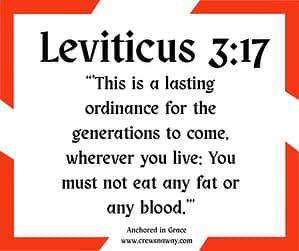
ANY FAT OR ANY BLOOD / LEVITICUS 3:17

START YOUR DAY RIGHT DAILY DEVOTION

(KJV) Leviticus 3:17

It shall be a perpetual statute for your generations throughout all your dwellings, that ye eat neither fat nor blood.

The Sacred Threshold: Honoring God with the Best of Life

Have you ever paused over the highly specific, detailed laws in the Old Testament and wondered, What does this have to do with my life today?

In Leviticus 3:17, we encounter a decree that sounds entirely foreign to modern ears: “It shall be a perpetual statute for your generations throughout all your dwellings, that ye eat neither fat nor blood.”

At first glance, it reads like an ancient dietary restriction. But when we look closer at the context of the peace offering, a profound spiritual truth emerges. Fat and blood were strictly reserved because they represent the very vitality and essence of life.

The Meaning Behind the Command

To understand why God claimed these specific portions, we have to look at what they symbolized to the ancient Israelites:

  • The Fat Belongs to the Lord: In biblical times, the fat was considered the richest, best, and most choice part of the animal. Offering the fat on the altar (Leviticus 3:16) was a symbolic way of giving God the absolute best of what they had. It represents our surplus, our strength, and our highest praise.
  • The Blood is the Life: As Leviticus 17:11 later clarifies, the life of the flesh is in the blood. Because the animal stood as a substitute for the worshiper, pouring out the blood represented giving the creature’s entire life over to God.

By demanding that His people abstain from eating the fat and the blood, God was establishing a boundary. He was reminding them that human life, and the sustenance that gives it strength, belongs ultimately to Him. We are stewards, not owners, of the breath in our lungs and the energy in our bodies.

Living “Fat and Blood” Today

We no longer bring animal sacrifices to a physical altar because Jesus Christ offered Himself as the ultimate substitute, pouring out His own blood to buy our redemption. However, the spiritual principle of Leviticus 3:17 remains a beautiful blueprint for our daily walk:

  1. Give God Your First and Best: Don’t give God your leftovers—the last five minutes of your day, or the money left over after everything else is spent. Give Him your “fat”—your primary energy, your focused time, and your best gifts.
  2. Recognize the Sacredness of Life: Because our life belongs to God, how we treat our bodies, our time, and our neighbors matters. Your vitality is a loan from the Creator, meant to be used for His glory.

When we surrender our best to God, we find that what He gives back to us is far more fulfilling than anything we could have held onto for ourselves.

A Closing Prayer

Heavenly Father,

We acknowledge today that our lives are not our own; we have been bought with a precious price. Forgive us for the times we have given You our leftovers instead of our best. Today, we choose to lay the “fat” of our lives—our energy, our talents, our time, and our resources—upon Your altar as a sweet aroma.

Thank You for the blood of Christ that purifies us and gives us eternal vital life. Help us to live this week with a deep reverence for the life You have entrusted to us, using every ounce of our strength to honor Your holy name.

In Jesus’ name, Amen.

Affiliate Disclosure: This post contains affiliate links. If you make a purchase through these links, I may earn a small commission at no extra cost to you.

Bible Study Tools I Use

Some of our Post That Might Interest You, All Out of the Current Book / Chapter

  1. FELLOWSHIP OFFERING / LEVITICUS 3:1
  2. NOT ANY YEAST OR HONEY / LEVITICUS 2:11
  3. GRAIN OFFERING / LEVITICU 2:1-2
  4. AROMA PLEASING TO THE LORD / LEVITICUS 1:9
  5. SLAUGHTER THE YOUNG BULL / LEVITICUS 1:5
  6. LAY HIS HAND ON / LEVITICUS 1:4
  7. BURNT OFFERING / LEVITICUS 1:3
  8. BRINGS AN OFFERING / LEVITICUS 1:2
  9. CREWS N AWAY: ANCHORED IN GRACE

Thanks for stopping by the blog today! I love having you here. If this post resonated with you, please drop a comment below and share your thoughts. See you in the next post!

Blessings, Margarita & Stace
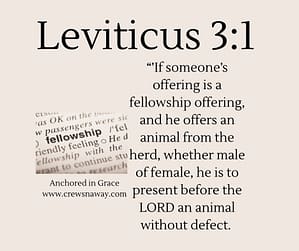
FELLOWSHIP OFFERING / LEVITICUS 3:1

START YOUR DAY RIGHT DAILY DEVOTION

(KJV) Leviticus 3:1

And if his oblation be a sacrifice of peace offering, if he offer it of the herd; whether it be a male or female, he shall offer it without blemish before the Lord.

The Gift of Nearness: Understanding the Fellowship Offering

Leviticus 3:1 introduces us to a beautiful, deeply personal ritual: the Fellowship Offering (sometimes called the Peace Offering). While old covenant regulations can sometimes feel distant or purely historic, this specific offering holds a profound truth about the very heart of God.

God did not establish the sacrificial system solely to deal with sin and guilt; He also designed a way for His people to simply enjoy His presence.

What Was the Fellowship Offering?

Unlike other offerings that focused strictly on atonement or cleansing, the fellowship offering was brought to God intentionally to cultivate intimacy and enjoy personal interaction with Him. It was a sacred meal shared, in a sense, between God, the priest, and the worshiper.

Scripture highlights a few primary reasons someone would bring this offering:

  • To Express Thankfulness: A spontaneous overflow of gratitude for God’s concrete blessings in daily life (Leviticus 7:12-16; 22:29).
  • To Fulfill a Vow: A meaningful expression of devotion and answered prayer (Leviticus 7:16).
  • To Celebrate Peace: A joyful declaration of renewed unity and harmony between God and the worshiper.

Bringing this offering required a complete commitment to God’s covenant—His “life agreement” built on divine law, promises, and the worshiper’s faithful obedience to His standards.

The Ultimate Fellowship: From Shadow to Reality

The rituals of Leviticus were a shadow of a much greater reality to come. This ancient ceremony directly anticipated the personal relationship that followers of Jesus now enjoy with God.

Through the cross, Christ became our final, perfect Fellowship Offering. Consider how the New Testament connects these dots:

  1. Peace Restored: Colossians 1:20 reminds us that Christ made peace through the blood of His cross, reconciling all things to Himself.
  2. True Community: Because we have peace with God, we can experience true unity with each other. As 1 John 1:3 states, “Our fellowship is with the Father and with his Son, Jesus Christ.”
  3. The Eternal Banquet: This offering also points forward to the ultimate family meal. It anticipates the day when all of God’s people will sit down for unbroken fellowship in His kingdom—a reality beautifully described in the wedding supper of the Lamb (Revelation 19:6-10).

You don’t have to earn your way into God’s presence today. Because of Jesus, the door is wide open for you to pull up a chair, sit with your Creator, and simply enjoy being loved by Him.

A Closing Prayer for Fellowship

Heavenly Father,

Thank You for being a God who doesn’t just rule from a distance, but invites us into close, personal fellowship. Thank You for Jesus, our ultimate Peace Offering, who tore down the walls of separation and made a way for us to know You intimately.

Forgive us for the times we treat our relationship with You like a duty rather than a delight. Help us to slow down today just to enjoy Your presence. Fill our hearts with a deep sense of gratitude, and let Your peace rule in our hearts and in our relationships with others. We look forward with joy to the day we will sit at Your eternal table.

In Jesus’ name, Amen.

Affiliate Disclosure: This post contains affiliate links. If you make a purchase through these links, I may earn a small commission at no extra cost to you.

Bible Study Tools I Use

Some of our Post That Might Interest You, All Out of the Current Book / Chapter

  1. NOT ANY YEAST OR HONEY / LEVITICUS 2:11
  2. GRAIN OFFERING / LEVITICU 2:1-2
  3. AROMA PLEASING TO THE LORD / LEVITICUS 1:9
  4. SLAUGHTER THE YOUNG BULL / LEVITICUS 1:5
  5. LAY HIS HAND ON / LEVITICUS 1:4
  6. BURNT OFFERING / LEVITICUS 1:3
  7. BRINGS AN OFFERING / LEVITICUS 1:2
  8. CREWS N AWAY: ANCHORED IN GRACE

Thanks for stopping by the blog today! I love having you here. If this post resonated with you, please drop a comment below and share your thoughts. See you in the next post!

Blessings, Margarita & Stace