A CALL TO REPENTANCE / MICAH 1:16

START YOUR DAY RIGHT DAILY DEVOTION
(KJV) Micah 1:16

Make thee bald, and poll thee for thy delicate children; enlarge thy baldness as the eagle; for they are gone into captivity from thee.

The Weight of Compromise: A Reflection on Micah 1:16

In the final verse of the opening chapter of his prophecy, Micah delivers a jarring, deeply uncomfortable command to the people of Judah: “Shave your head in mourning for the children in whom you delight; make yourself as bald as the vulture, for they will go from you into exile.”

In the ancient Near East, shaving one’s head was far more than a change in appearance; it was a visceral, outward sign of overwhelming sorrow. By commanding this, Micah was warning the people to expect a time of great grief over a coming tragedy that was now unavoidable. The impending judgment would not be a distant political shift; it would be intensely personal and severe. Their most precious gifts—their children—would be forcefully taken from them and carried away into captivity.

Through these heavy words, Micah made it clear that God’s people could not reject the Lord without suffering terrible consequences. For generations, the people of Israel and Judah had attempted to walk a dangerous tightrope. They wanted the blessings and security of being God’s chosen people, yet they constantly sought to mimic the cultures, idols, and faithless practices of the nations around them. They chose compromise over covenant, drifting further away from the truth until their lives no longer bore any resemblance to the holiness God required.

This ancient warning echoes loudly for modern believers. The temptation to conform to the surrounding culture remains incredibly strong. Those who turn away from God, or gradually find no place in their daily lives for Him and His Word as they try to look and act like everyone else, face a dangerous spiritual reality. By aligning our hearts with the values of a broken world, we inadvertently find ourselves standing against Christ and open to spiritual disaster.

The consequences of compromise are rarely confined to ourselves. Just as the rebellion of Judah directly impacted the destiny of their children, our choices today shape the spiritual environment of the next generation. True repentance requires us to acknowledge the weight of our drift, turn back to the Word of God, and realign our lives with His truth before the consequences of our compromise catch up to us.

A Closing Prayer for Repentance and Alignment

Heavenly Father,

We come before You today with humbled hearts, recognizing the gravity of Your truth found in the words of the prophet Micah. Lord, we confess that too often we allow ourselves to drift, seeking to fit into the world around us rather than standing firm in Your righteousness. Forgive us for the times we have marginalized Your Word and chosen the path of cultural compromise.

We ask for the grace to live lives that honor You completely. Guard our hearts against the subtle deceptions that pull us away from Christ, and give us the courage to reject anything that sets itself up against Your truth. We pray for our families, our communities, and the next generation. May our homes be places of uncompromised faith, rooted deeply in Your love and obedience to Your commands. We place our lives in Your hands, trusting in Your mercy and Your steadfast devotion.

In Jesus’ name, we pray. Amen.

Affiliate Disclosure: This post contains affiliate links. If you make a purchase through these links, I may earn a small commission at no extra cost to you.

Bible Study Tools I Use

Some of our Post That Might Interest You, All Out of the Current Book / Chapter

  1. GATH … BETH OPHRAH / MICAH 1:10-15
  2. IT HAS COME TO JUDAH / MICAH 1:9
  3. I WILL WEEP AND WAIL / MICAH 1:8-9
  4. SAMERIA A HEAP OF RUBBLE / MICAH 1:6
  5. TRANSGRESSION … SINS / MICAH 1:5
  6. MICAH – SAMARIA AND JERUSALEM / MICAH 1:1
  7. CREWS N AWAY: ANCHORED IN GRACE

Thanks for stopping by the blog today! I love having you here. If this post resonated with you, please drop a comment below and share your thoughts. See you in the next post!

Blessings, Margarita & Stace
GATH … BETH OPHRAH / MICAH 1:10-15

START YOUR DAY RIGHT DAILY DEVOTION

(KJV) Micah 1:10-15

The Sound of Judgment: Wordplay and Heartbreak in Micah 1:10-15

Have you ever experienced a moment where words fail, yet somehow mean everything all at once?

In Micah 1:10–15, the prophet Micah faces the ultimate heartbreak. He sees the Assyrian army marching toward Jerusalem, swallowing up the small, rural towns of his childhood. But instead of giving a dry military report, Micah uses brilliant Hebrew wordplays (puns with a double meaning) to deliver his message.

To the ancient listener, the name of each town sounded exactly like the specific tragedy about to hit it. It is a masterful, agonizing literary device—a funeral dirge written in the geography of his own home.

Let’s look at how Micah uses these clever wordplays to show that no one can hide from God’s justice, and how he finds hope even in the wreckage.

The Puns of Judgment

In Hebrew, the names of these cities carry a deep irony. When Micah calls them out, he is telling them that their very identities are being turned upside down:

  • Gath (sounds like the Hebrew word for “tell”): “Tell it not in Gath.” This is a callback to King David’s famous lament. Micah is saying, “Do not let our pagan neighbors rejoice over our downfall.”
  • Beth Ophrah (means “House of Dust”): “In the house of dust roll yourself in the dust.” A town defined by its stability is reduced to a pile of mourning ash.
  • Shaphir (means “Beautiful” or “Pleasant”): “Pass on your way, inhabitants of Shaphir, in nakedness and shame.” The beautiful city will be stripped and humiliated by captors.
  • Zaanan (sounds like “come out”): “The inhabitants of Zaanan do not come out.” The town whose name implies movement will be completely frozen by fear and under siege.
  • Maroth (means “Bitterness”): “For the inhabitants of Maroth wait anxiously for good, because disaster has come down from the Lord.” The people of Bitterness will taste the ultimate bitterness of judgment.

Why the Wordplay Matters

Micah isn’t just showing off his poetic skills. He is making a profound point about human pride.

The people of Judah trusted in their fortresses, their regional identities, and their geographical security. Micah uses the very names they took pride in to show that apart from God, our earthly security is an illusion. The things we think protect us can become the very symbols of our collapse if our hearts are far from the Lord.

Yet, even in this heavy text, Micah ends with a spark of ultimate hope. He mentions Adullam—the famous cave where David hid when he was an outcast. By evoking Adullam, Micah subtly reminds the people that even when everything is stripped away and the nation is reduced to a remnant hiding in caves, God still preserves a royal line. Out of the dust, a King will still come.

A Closing Prayer

Lord God, You are a God of justice, but You are also a God who weeps over our brokenness. Like Micah, help us to see the world with clear eyes and broken hearts, never becoming numb to the pain around us. Forgive us for the times we put our trust in our own fortresses—our finances, our status, or our comfort. Turn our hearts back to You, our only true security. When our world shakes, remind us of the Cave of Adullam; remind us that You protect the outcast and preserve Your promises even in the darkest valleys. In Jesus’ name, Amen.

Affiliate Disclosure: This post contains affiliate links. If you make a purchase through these links, I may earn a small commission at no extra cost to you.

Bible Study Tools I Use

Some of our Post That Might Interest You, All Out of the Current Book / Chapter

  1. IT HAS COME TO JUDAH / MICAH 1:9
  2. I WILL WEEP AND WAIL / MICAH 1:8-9
  3. SAMERIA A HEAP OF RUBBLE / MICAH 1:6
  4. TRANSGRESSION … SINS / MICAH 1:5
  5. MICAH – SAMARIA AND JERUSALEM / MICAH 1:1
  6. CREWS N AWAY: ANCHORED IN GRACE

Thanks for stopping by the blog today! I love having you here. If this post resonated with you, please drop a comment below and share your thoughts. See you in the next post!

Blessings, Margarita & Stace
IT HAS COME TO JUDAH / MICAH 1:9

START YOUR DAY RIGHT DAILY DEVOTION

(KJV) Micah 1:9

 For her wound is incurable; for it is come unto Judah; he is come unto the gate of my people, even to Jerusalem.

When the Infection Spreads: The Incurable Wound of Judah

It is a dangerous thing to watch a neighbor experience fallout for their choices and think, “That could never happen to me.”

In Micah 1:9, the prophet delivers a chilling diagnosis to the southern kingdom of Judah: “For her wound is incurable; for it has come to Judah; he is come unto the gate of my people, even to Jerusalem”.

The northern kingdom of Israel (Samaria) had already collapsed under the weight of its own idolatry and systemic corruption. Instead of seeing this collapse as an urgent warning to repent, Judah looked on with a false sense of security. They assumed their heritage, their temple, and their strategic alliances made them immune.

They were wrong. Judah was just as guilty as Israel in breaking God’s laws and rebelling against Him.

The Illusion of Safety

Judah had no reason to feel relieved simply because they didn’t face judgment at the exact same moment as Samaria. Sin is not localized; it is infectious. The same spiritual rot that destroyed the north had quietly compromised the gates of the south.

To shock the people out of their complacency, Micah bypasses generic warnings and begins naming specific towns in Judah (Micah 1:10–16), calling on them to mourn in advance for the destruction heading their way. Through clever wordplay on each town’s name, he paints a grim picture of their impending capture:

  • Beth-le-aphrah (House of Dust) would roll in the dust.
  • Achzib (Deception) would prove to be a deception to the kings of Israel.
  • Mareshah (Inheritance) would look on as a new conqueror claimed them as an inheritance.

Micah wasn’t exaggerating. This prophecy met its literal, brutal fulfillment when Sennacherib, King of Assyria, invaded Judah (as recorded in 2 Kings 18:13). Secular history validates this biblical account: according to ancient Assyrian records like Sennacherib’s Prism, the Assyrian army successfully conquered 46 of Judah’s walled cities, pinning King Hezekiah inside Jerusalem “like a bird in a cage”.

The Lesson for Us Today

The “incurable wound” of Micah 1:9 reminds us that delaying judgment does not mean avoiding it. When we see others encounter the consequences of compromised values, our response shouldn’t be pride or relief—it should be self-examination.

God’s standard of justice does not shift based on our past credentials or our social standing. The only true cure for a spiritual wound that threatens to become terminal is swift, wholehearted repentance before the damage arrives at our own gates.

Closing Prayer

Heavenly Father,

We come before You recognizing that it is easy to spot the failures of others while remaining blind to our own rebellion. Forgive us for the times we have felt secure in our compromises, assuming that Your patience gives us a license to persist in sin.

Lord, guard our hearts against false security. Do not let us wait until the consequences are at our very gates before we turn back to You. Give us the humility to examine our lives honestly, the courage to confess our hidden faults, and a deep desire to walk justly, love mercy, and walk humbly with You.

Where we are wounded by our own choices, we ask for the healing that only Your grace can provide. We ask these things in Your holy name, Amen.

Affiliate Disclosure: This post contains affiliate links. If you make a purchase through these links, I may earn a small commission at no extra cost to you.

Bible Study Tools I Use

Some of our Post That Might Interest You, All Out of the Current Book / Chapter

  1. I WILL WEEP AND WAIL / MICAH 1:8-9
  2. SAMERIA A HEAP OF RUBBLE / MICAH 1:6
  3. TRANSGRESSION … SINS / MICAH 1:5
  4. MICAH – SAMARIA AND JERUSALEM / MICAH 1:1
  5. CREWS N AWAY: ANCHORED IN GRACE

Thanks for stopping by the blog today! I love having you here. If this post resonated with you, please drop a comment below and share your thoughts. See you in the next post!

Blessings, Margarita & Stace
I WILL WEEP AND WAIL / MICAH 1:8-9

START YOUR DAY RIGHT DAILY DEVOTION

(KJV) Micah 1:8-9

Therefore I will wail and howl, I will go stripped and naked: I will make a wailing like the dragons, and mourning as the owls. 9 For her wound is incurable; for it is come unto Judah; he is come unto the gate of my people, even to Jerusalem.

Grieving the Fall: What Micah 1:8-9 Teaches Us About a Broken World

When we read the Old Testament prophets, it is easy to view their declarations as cold announcements of doom. We sometimes imagine them standing on street corners, shouting warnings with detached anger. But a closer look at the text reveals a completely different posture. The prophets did not just carry God’s truth; they carried His heartbreak.

In Micah 1:8-9, we witness a powerful, visceral display of prophetic grief:

“Because of this I will weep and wail; I will go about barefoot and naked. I will howl like a jackal and moan like an owl. For Samaria’s plague is incurable; it has spread to Judah. It has reached the very gate of my people, even to Jerusalem itself.”

Understanding Micah’s Tears

To fully appreciate Micah’s anguish, we have to look at the context of his world. In Micah 1:6, God announces the imminent fall of Samaria, the capital of the northern kingdom of Israel. Samaria had long rejected God, turning instead to idolatry, injustice, and spiritual rebellion. Now, the consequences of those choices had caught up to them.

Micah was a prophet from Judah, the southern kingdom. Samaria was Judah’s sister nation—sharing the same ancestral roots, the same covenant history, and the same spiritual heritage. Watching Israel collapse under the weight of her own sin devastated Micah. He didn’t gloat. He didn’t claim spiritual superiority. Instead, he stripped off his outer garments, went barefoot, and wailed with agonizing cries that sounded like wild animals in the desert.

Why such deep sorrow? Because Micah loved the Lord, and he loved his people. He understood that the “incurable wound” of Samaria’s rebellion was already creeping toward the gates of his own home in Jerusalem.

The Posture of a Faithful Heart

Micah’s grief challenges us deeply today. How do we respond when we see people around us rejecting God, making destructive choices, and wandering down paths that lead to their own ruin?

It is incredibly easy to fall into the traps of cynicism, apathy, or self-righteous judgment. We see the brokenness of culture, or the painful choices of individuals, and our immediate reaction might be anger or isolation.

But God’s faithful people should always experience a sense of sorrow when others continue to rebel against Him. Micah laments because he reflects the very heart of God. Judgment and destruction bring God no pleasure; our sin pains Him. Centuries after Micah, Jesus stood on a hill overlooking Jerusalem and wept over the city because the people refused to turn to Him for peace.

True faith doesn’t harden our hearts toward a fallen world; it softens them. It calls us to weep for the brokenness around us, to mourn over the devastating reality of sin, and to earnestly pray for restoration.

Closing Prayer

Heavenly Father,

We look at the world around us and acknowledge the deep brokenness, confusion, and rebellion that grieves Your heart. Forgive us for the times we have responded with judgment, self-righteousness, or indifference instead of the love and compassion You have shown us.

Lord, give us a heart like Micah’s. Help us to feel a holy sorrow for those who are walking toward their own destruction. Soften our hearts so that we might weep for the hurting and pray urgently for the lost. We thank You that even when human wounds seem incurable, You sent Your Son, Jesus Christ, to bring ultimate healing, forgiveness, and hope. Use us as instruments of Your grace and truth to a world that desperately needs You.

In Jesus’ name, Amen.

Affiliate Disclosure: This post contains affiliate links. If you make a purchase through these links, I may earn a small commission at no extra cost to you.

Bible Study Tools I Use

Some of our Post That Might Interest You, All Out of the Current Book / Chapter

  1. SAMERIA A HEAP OF RUBBLE / MICAH 1:6
  2. TRANSGRESSION … SINS / MICAH 1:5
  3. MICAH – SAMARIA AND JERUSALEM / MICAH 1:1
  4. CREWS N AWAY: ANCHORED IN GRACE

Thanks for stopping by the blog today! I love having you here. If this post resonated with you, please drop a comment below and share your thoughts. See you in the next post!

Blessings, Margarita & Stace
SAMERIA A HEAP OF RUBBLE / MICAH 1:6

START YOUR DAY RIGHT DAILY DEVOTION

(KJV) Micah 1:6

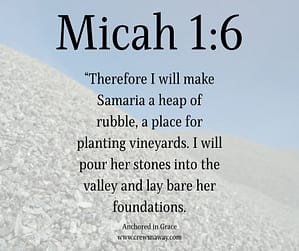
Therefore I will make Samaria as an heap of the field, and as plantings of a vineyard: and I will pour down the stones thereof into the valley, and I will discover the foundations thereof.

The Ruins of Samaria: What Happens When We Build on Hollow Ground?

We often treat prophetic warnings in Scripture as distant history, but the physical ruins of the ancient world tell a different story. In Micah 1:6, God delivers a stark and sobering decree against the capital of the northern kingdom of Israel:

“Therefore I will make Samaria a heap of rubble in the open country, a place for planting vineyards. I will pour her stones down into the valley and lay bare her foundations.”

This wasn’t structural hyperbole; it was an exact architectural blueprint of judgment.

Built on False Wealth and Spiritual Infidelity

Samaria was the crown jewel of Israel’s economic and political power. Yet, underneath its polished exterior, the city was completely hollow. As the prophet Micah pointed out, Samaria’s massive wealth was built entirely on ungodliness—described vividly as “the wages of prostitutes” (Micah 1:7).

In the ancient near east, this phrase carried a dual sting. Literally, it pointed to the physical wealth poured into pagan temples through ritual prostitution. Spiritually, it exposed Israel’s deep unfaithfulness to God. They traded their devotion to Yahweh for cultural compromise, idol worship, and the systemic exploitation of the vulnerable. They assumed their material success meant they were safe.

When the Foundations Fail

The warning was ignored, but the consequence was swift. In 722 B.C., the Neo-Assyrian Empire laid siege to the city, completely destroying Samaria and carrying its people into exile, exactly as detailed in 2 Kings 17:1-6. The very stones Israel used to build their proud palaces were overturned and tumbled into the valley below.

The historical lesson of Samaria is a timeless truth: Wealth, status, and success gained at the expense of our spiritual integrity cannot stand. When we build our lives on compromise, we are building on foundations that God has already promised to lay bare.

Where Are We Building?

It is incredibly easy to fall into the same traps as ancient Samaria. We might not build physical alters to foreign gods, but we can easily sacrifice our integrity, our families, and our peace for material gain or cultural validation.

When our habits favor comfort over conviction and self-interest over justice, we risk building our own modern “heaps of rubble”. True security is never found in the abundance of what we accumulate, but in the structural integrity of a life aligned with God’s truth.

A Closing Prayer

Heavenly Father,

We come before You recognizing that You see past our outward success and look straight into the foundations of our hearts. Forgive us for the times we have chased after the “wages of compromise,” valuing temporary comfort or worldly security above our devotion to You.

Do not let us build our lives on hollow ground. Where there is hidden pride, spiritual compromise, or unfaithfulness, expose it gently by Your grace before it leads to ruin. Give us the courage to tear down our own high places and instead build our lives on the solid rock of Your truth, justice, and mercy.

Establish the work of our hands only for Your glory, and keep our hearts entirely Yours.

In Jesus’ name, Amen.

Affiliate Disclosure: This post contains affiliate links. If you make a purchase through these links, I may earn a small commission at no extra cost to you.

Bible Study Tools I Use

Some of our Post That Might Interest You, All Out of the Current Book / Chapter

  1. TRANSGRESSION … SINS / MICAH 1:5
  2. MICAH – SAMARIA AND JERUSALEM / MICAH 1:1
  3. CREWS N AWAY: ANCHORED IN GRACE

Thanks for stopping by the blog today! I love having you here. If this post resonated with you, please drop a comment below and share your thoughts. See you in the next post!

Blessings, Margarita & Stace
TRANSGRESSION … SINS / MICAH 1:5

START YOUR DAY RIGHT DAILY DEVOTION

(KJV) Micah 1:5

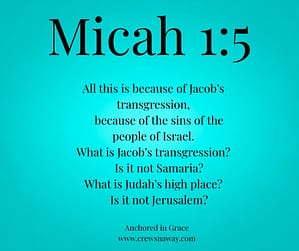
For the transgression of Jacob is all this, and for the sins of the house of Israel. What is the transgression of Jacob? is it not Samaria? and what are the high places of Judah? are they not Jerusalem?

Confronting the Roots of Compromise: Reflections on Micah 1:5

The words of the minor prophets often strike with the force of a sudden storm, cutting through spiritual complacency and exposing the hidden fractures in our devotion. In Micah 1:5, the prophet delivers a piercing diagnostic of God’s covenant people: “All this is for the transgression of Jacob and for the sins of the house of Israel. What is the transgression of Jacob? Is it not Samaria? And what are the high places of Judah? Are they not Jerusalem?”

To understand the weight of this indictment, we must look at the names used. Micah addresses “Jacob,” the foundational name of Israel. Jacob, the grandson of Abraham and son of Isaac, received the name Israel from God as a marker of identity and destiny. Yet here, the name is invoked not to celebrate their heritage, but to highlight how far the nation had fallen from its calling.

The core issue is summarized in two heavy words: transgression and sin. In the context of Micah’s message, these were not vague or abstract concepts. The people were facing divine judgment for specific, widespread offenses against God. They had compromised their devotion by worshiping false gods, blending the holy commands of Yahweh with pagan rituals. This spiritual corruption directly fueled societal decay. The culture was marked by rampant immorality, violence, and systematic injustice. As Micah later notes, powerful elite figures lay awake plotting evil, using their influence to seize fields, rob families of their inheritance, and oppress the vulnerable.

Micah highlights a sobering truth about how sin spreads: it often flows from the top down. The prophet explicitly names Samaria and Jerusalem—the capital cities. These centers of political, economic, and cultural influence had become the epicenters of rebellion. The spiritual rot that began in the palaces and high places quickly trickled down, poisoning the daily lives and practices of everyday people throughout the entire land.

This ancient warning remains deeply relevant today. It challenges us to examine the “capital cities” of our own lives—the primary influences, ambitions, and leadership priorities that shape our daily actions. When we tolerate spiritual compromise or ignore injustice in our spheres of influence, the impact inevitably ripples outward, affecting our families, our communities, and our character. Micah 1:5 invites us to stop shifting blame, confront our transgressions honestly, and return to a standard of true righteousness and justice.

Closing Prayer

Heavenly Father, You are holy, just, and deeply grieved by the ways we compromise our faith. We confess that, like ancient Israel, we often allow cultural idols, self-interest, and indifference to injustice to take root in our hearts and communities. Forgive us for our transgressions and the subtle ways we wander from Your truth. We ask that You search our hearts today. Cleanse the areas where we have allowed compromise to rule, and let Your Holy Spirit revive a passion for true righteousness within us. Help us to act justly, love mercy, and walk humbly with You every day. In Jesus’ name, Amen.

Affiliate Disclosure: This post contains affiliate links. If you make a purchase through these links, I may earn a small commission at no extra cost to you.

Bible Study Tools I Use

Some of our Post That Might Interest You, All Out of the Current Book / Chapter

  1. MICAH – SAMARIA AND JERUSALEM / MICAH 1:1
  2. CREWS N AWAY: ANCHORED IN GRACE

Thanks for stopping by the blog today! I love having you here. If this post resonated with you, please drop a comment below and share your thoughts. See you in the next post!

Blessings, Margarita & Stace
MICAH – SAMARIA AND JERUSALEM / MICAH 1:1

START YOUR DAY RIGHT DAILY DEVOTION

(KJV) Micha 1:1

The word of the Lord that came to Micah the Morasthite in the days of Jotham, Ahaz, and Hezekiah, kings of Judah, which he saw concerning Samaria and Jerusalem.

Finding Hope in the Hard Truths: A Deep Dive into Micah 1:1

We often look at the ancient prophets as distant figures shouting warnings from the pages of history. But when you step closer, you realize their world looked remarkably like ours. They faced political chaos, moral confusion, and spiritual decline.

In Micah 1:1, we get our introduction to a man who refused to stay silent during a cultural breaking point.

The Man and His Moment

Micah came from Moresheth, a small rural town in southern Judah. He was a country preacher stepping into a big-city crisis. Prophesying roughly between 750 and 687 B.C., Micah operated in a crowded, powerful era of spiritual leadership.

He shared the cultural stage with two other massive biblical figures:

  • Isaiah, who spoke directly to the royal courts of Jerusalem (Isaiah 1:1).
  • Hosea, who poured out his heart to the fracturing northern tribes (Hosea 1:1).

While Micah’s primary mission field was his home turf of Judah (the Southern Kingdom), his vision was broad. God gave him a message that spanned the entire divided nation, demanding the attention of both the South and the North.

A Tale of Two Corrupt Capitals

Micah 1:1 specifically sets the stage for a confrontation with Samaria and Jerusalem.

  • Samaria was the glittering capital of Israel.
  • Jerusalem was the historic capital of Judah.

On the outside, these cities were centers of wealth, power, and political strategy. On the inside, they were spiritually bankrupt. Both nations had largely abandoned their covenant faith in God. They traded true worship for empty rituals and systemic injustice.

Because of this spiritual rebellion, the verses immediately following Micah’s introduction paint a terrifying picture. Micah warns that the Lord Himself is “coming down” (Micah 1:3) to execute judgment on these wayward cities (Micah 1:5-7). The very foundations of their false security were about to be shaken.

The Tension of Truth: Judgment and Mercy

If Micah’s message stopped at judgment, it would be a tragedy. But the beauty of Micah’s ministry lies in its balance.

Yes, Micah’s main theme is judgment. He refuses to sugarcoat the consequences of sin. He delivers stark prophecies of doom to a culture that thought it was untouchable.

But right alongside those warnings, Micah weaves a beautiful thread of God’s mercy, salvation, and ultimate restoration. He reminds us that God’s judgment is never meant to destroy us, but to discipline and purify us. For every verse of warning, there is a promise of hope.

Why It Matters Today

Micah 1:1 matters because it reminds us that God sees beneath our religious surfaces. He cares about our hearts, our justice, and our devotion. When we wander, He will disrupt our comfort to get our attention.

But more than anything, Micah reminds us that no matter how dark the cultural landscape gets, God’s final word is always hope.

A Closing Prayer

Heavenly Father,

Thank You for the timeless truth of Your Word. Like the people of Samaria and Jerusalem, we admit that our hearts can easily wander into empty rituals and false security. Forgive us for the times we prioritize our own comfort over Your justice and mercy.

Give us the courage of Micah to face the hard truths in our own lives. Disrupt our complacency and draw us back to Your heart. Thank You that Your ultimate desire is not to condemn us, but to restore and redeem us. We rest today in Your perfect balance of justice and grace, knowing that Your final word over our lives is always hope.

In Jesus’ name, Amen.

Bible Study Tools I Use

Some of our Post That Might Interest You, All Out of the Current Book / Chapter

  1. CREWS N AWAY: ANCHORED IN GRACE

Thanks for stopping by the blog today! I love having you here. If this post resonated with you, please drop a comment below and share your thoughts. See you in the next post!

Blessings, Margarita & Stace